Tuesday, July 21, 2015

North Wales

We left Pembrokeshire and headed toward North Wales at the beginning of July with a number of stops planned. Although I was born and lived quite a few years in Wales, I had never been to the top of  Mount Snowdon, nor visited Portmeirion, so we planned to include those in our journeys.
We traveled up the coast and made brief stops in the area where I had my first job, Aberporth, and the local market town of Cardigan.


This is the beach at Aberporth, where I spent a lot of time during the summers when I worked nearby. I actually lived in the village that adjoins this beach, and have a lot of happy memories from this part of the world.


I had often wanted to visit CAT, the Center for Alternative Technology, so we stopped by for a short visit. CAT is just outside the town of  Machynlleth and, for the past 40 years has focused on all aspects of sustainable living. It was interesting to see all of the demonstrations of power generation, sustainable buildings and organic agriculture.


The next stop was a two-night stay in the town of Criccieth, which is on the coast and close to Portmeirion, the focus of our visit here. You will notice there is also a castle here.


We arrived early at Portmeirion and found it fairly quiet, no doubt because of the rain! We took a great number of photographs and stayed most of the day, as the rain did stop, but it continued to blow a gale. Fortunately, Portmeirion is quite sheltered, making for a fun visit.


Well, at least when the rain stopped.

 Wind still blowing........


The whole village is a collection of Italian style houses and villas, built between 1925 and 1975 by Sir Clough Williams-Ellis.  His goal was to create a beautiful place to attract artists and holiday-makers.   His grandson is still involved today.


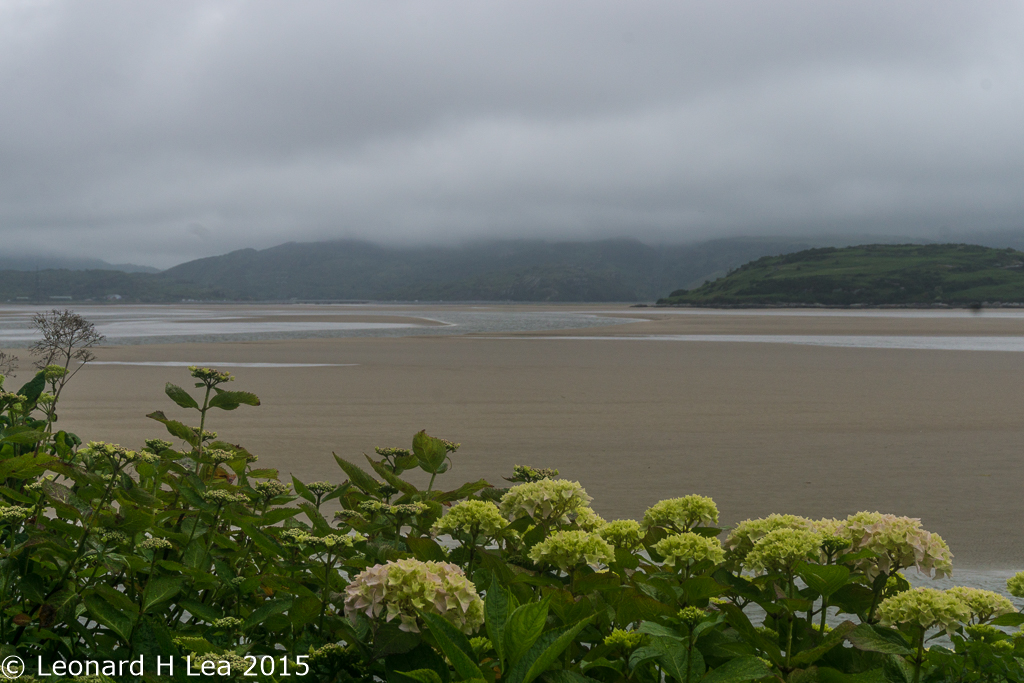
The village overlooks this wide river estuary with huge expanses of sand exposed at low tide.


Portmeirion also has an artist residency program and this is Briony Clarke, the current artist. We had a very long and interesting visit with her  and discussions about her art form.  She has created an interesting process of letting the incoming sea deposit natural inks onto submerged paper, quite amazing.


A quick glimpse of Criccieth castle with the stiff wind still blowing as we moved on to the next North Wales stop.


I realize that reading the Welsh place names may be a challenge for some, but this is the small town we stopped in next. The main focus was to take the train to the top of  Mount Snowdon. We could have hiked up and down, but we took the easy way up. As mountains go, it is not very high, but has a lot of demanding sections for climbers and as such, Edmund Hillary practiced here before he and his team made the first successful ascent of Mount Everest.


The train track to the summit is quite steep and the engines engage a toothed center rail to provide the necessary "grip".


Some pretty steep drop-offs.


As I said, we could have walked. this is one view of the path. We saw one group who had ridden/pushed their mountain bikes to the top and presumably were going to ride down!


The summit was in low cloud when we got there, but I managed to climb to the actual summit.


Diane didn't want go any higher!


The weather can be highly changeable, this was the scene as we descended the mountain.


Next stop was Bodnant Gardens, one of the best gardens in Britain. It is a National Trust property and is really well maintained. The house is privately owned and not open to the public.

The roses were in full bloom and were just beautiful.


The house is beautifully situated and looks over many acres of gardens and lawns.

The lily pond.

It was a bit early for a big display of lilies in flower, but there were a few to photograph.

 This building is the resting place for many generations of the family that originally owned this house and garden. It is only open once a month and we were fortunate to be in the garden on one of those days.

It was quite dark inside, but the little Sony did a pretty good job of getting an idea of the details.


We made a stop in Betws-y Coed, probably the most miss-pronounced village name in Wales!


This is the kind of rugged countryside that we drove through, makes you realize why there are so many sheep farms in this part of Wales.


We stopped in Ruthin, the home town of a good friend.


I thought it was just another rock until I looked closer!


 Well, I guess it was good to be King.

Next stop Chester and then on to the the Lake District.

Thursday, July 16, 2015

Pembrokshire

We headed towards West Wales for the fourth week of June and stayed in a self-catering cottage on a farm in Pembrokshire. One of Diane's goals for this trip was to walk a portion of the coastal path. Wales is the first country in the world to have a path that follows most of the country's coastline. The total length is some 870 miles,which is quite impressive for a country that is only about 100 miles or so from top to bottom.  Pembrokeshire was chosen because the coastal path here follows tall cliffs and broad expanses of heath.

On our drive west we stopped in Abergavenny, another small market town with a history back to Roman times.

It was a lovely day and it was also a market day, so the town was buzzing.


The roads we traveled were mostly quiet, as the M4 motorway takes most of the heavy traffic that used to plague the them.


Though, occasionally you get to follow large tractors on their way to another field.


Wales has a large sheep population and we saw them covering mountain sides throughout our travels.


Our accommodation was this converted stable on quite a large farm, lovely and quiet, though down a very rough lane which bounced us around quite a lot as we drove in and out.


We were very close to the village of Carew, which, of course, had a castle! This site also has a tidal mill which was used to grind local grain into flour.


This  is the mill which stands on a wall that is used to hold the area at the front of the photo full of water when the tide comes in from the sea. The trapped water was then released back through the water wheels in the mill, that then turned the grinding stones.


We were also close to the seaside town of Tenby which has very large expanses of sandy beach. Another characteristic, it too, has a castle as well as being a walled town.


As I said earlier, one of our goals was to take walks on the coastal path. Walking these paths is made quite easy with bus routes that stop at many of the access points, making it easy to leave your car at one end of a section and take a bus back.


Our first walk started in Saundersfoot and ended in Tenby, a distance of about 4 miles. It was a great walk, though with a lot of hills and steep slopes to navigate. In many ways it reminded us of walks along the Oregon coast.


It was quite a strenuous walk but there were families out for the day as well.


The cliffs we walked along.


Great swaths of foxgloves everywhere.


And eventually we walked into Tenby where, after tea and snacks, we caught the bus back to the car we had left in Saundersfoot.

Another view of Tenby.


We saw that the local lifeboat had been out, exercises we hoped, and saw how they winched the boat back into the boathouse at the top of the ramp.


Saint David's is a very small city in the west of Pembrokshire, home to this cathedral. Saint David is the patron saint of Wales and within this cathedral is a shrine to commemorate his existence, since there is no record of where he is buried.


The church is quite magnificent and was the first I encountered that requested you buy a photographer's permit, cost about $3.50. A way of getting funding, as none is provided by the State.


Details of some of the vaulted roofs.


Wonderful floor tiles.


There was another section of the coastal path, near Saint David's, that we walked, out a headland, which had the remains of an Iron Age fort.


The walk is spectacular with views down into small bays with very clear water.


We made it to the headland and found a friendly New Zealander to take our photo.

 Diane taking a break next to a cromlech or ancient burial site, some 5,000 years old.


 We also walked yet another section of the coastal path that intersected with this beach near the village of Angle.


 A pretty deserted beach!


Lots of free roaming horses.


 Some wanted to talk to Diane.


The village of Laugharne, where Dylan Thomas lived at the end of his life, was close to where we were staying, so a visit was in order.


His writing shed, viewed through the window, as it is not open to the public.


 The "Boathouse", the home of Dylan and Caitlan Thomas.


Tea on the terrace of the house. We really enjoyed Laugharne, it has that small town feeling that we like.


The hotel bar where he used to hang out.


A simple marker for Dylan and Caitlin's last resting place.


Laugharne does, of course, have it's own castle.

We had a wonderful time in Pembrokeshire and were blessed with mostly good weather, which made our walks very enjoyable. It was difficult to cull a few photos from the 600 plus to show in this post, many more memorable ones will have to wait their turn.
North Wales next stop!